
· by Michael Blair, Nashville's Gutters
A roof collects a very large volume of water and gutters concentrate it into a few points. Where those points discharge decides how much water reaches the soil against your foundation, and on a downspout and drainage job it’s the first thing we look at.
How far from the foundation should a downspout discharge?
Six to ten feet from the foundation is the distance you’ll see recommended most often, and further on a lot that slopes back toward the house. We haven’t found it written into a code we can cite for a single house, so we treat it as a working rule rather than a requirement. In our experience a splash block on its own seldom gets the water that far.
The water also has to keep going once it lands. EPA’s brief guide to mold, moisture and your home asks for ground that slopes away from the foundation so water doesn’t enter or collect around it, and a ten-foot extension that empties into a low spot draining back toward the house does little to protect it.
Buried extensions
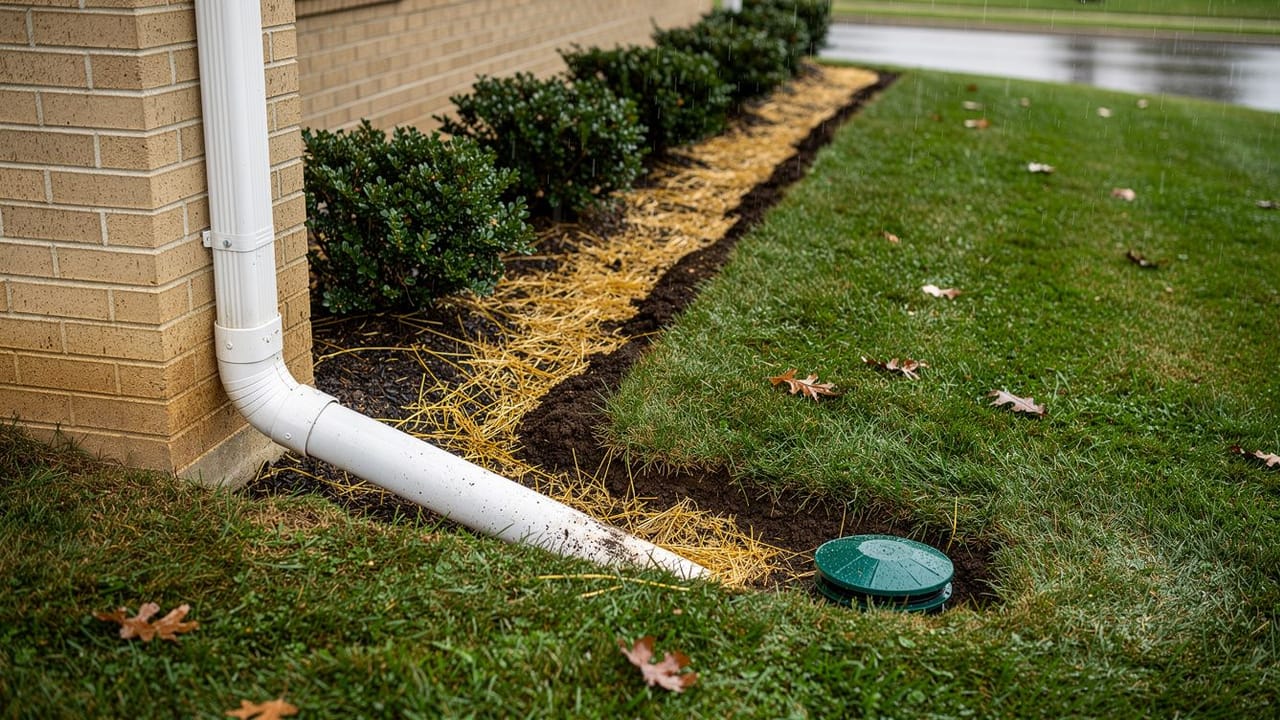
Rigid PVC run to a daylight outfall is what we install. Flexible corrugated pipe is the other common choice, and the runs of it we dig up have usually sagged between supports, held water in the dips and silted until they blocked. Telling that kind of blockage apart from a jammed downspout is its own job, which we walk through in our post on clogged downspouts and buried drain lines.
We put a cleanout at the top of each run and a pop-up or grate at the outfall, and we check that the fall is continuous rather than dipping. Where the pipe ends matters as much as how it gets there. In Nashville, Metro’s sewer use ordinance (Metro Code 15.60) bars rooftop drainage from being connected to the community sewer unless no storm sewer or other reasonable alternative exists, and even then only under a discharge permit with the fee paid. We keep roof water out of footing drains as well, since the point of the job is to carry water away from the footing rather than deliver it there.
- Six to ten feet as a working rule, more on adverse slope
- Rigid PVC rather than flexible corrugated
- Continuous fall to a daylight outfall
- Cleanout access at the top of the run
- Kept out of the footing drain and the sanitary sewer
Where should a downspout drain on a flat lot?
Where there is no lower ground, a dry well is one option, and it has to be sized for how slowly the soil underneath takes water. Metro’s stormwater manual section on infiltration trenches is written for developments rather than a single house, but its cautions are worth knowing: size from a measured percolation rate, take geotechnical borings first, never build on karst, and avoid drainage areas with clay or silt soils that would clog the stone. It also suggests keeping those structures 25 feet from a building foundation.
So we test percolation rather than assume it. The manual expects an infiltration system to drain completely within 24 to 48 hours after a storm, and it reads water still standing after three dry days as a sign of clogging. A dry well in clay that can’t drain is a buried tank of water sitting beside your house. Where one won’t work, Metro Water Services’ rain barrel page points out that catching stormwater from gutters and downspouts reduces runoff, and a barrel can hold back some of what one downspout delivers.
What it prevents
Water that collects against a foundation is what this whole job is meant to stop. EPA’s guide calls moisture control the key to mold control in a home, and two of its steps are cleaning and repairing roof gutters regularly and keeping the ground sloped away from the foundation, which is the work a gutter cleaning visit and a downspout extension do between them. We won’t put a figure on how much foundation movement around Middle Tennessee traces back to roof water, because we haven’t found anyone who has measured it.
Moving where a downspout empties is one of the smaller jobs we take on. If you’d like us to look at where yours discharge and where the water goes from there, ask us for a free estimate.
Sources
- U.S. EPA, A Brief Guide to Mold, Moisture and Your Home — Ground should slope away from the foundation so water does not enter or collect around it; clean and repair roof gutters regularly; moisture control is the key to mold control
- Metro Nashville Water Services, Sewer Use Ordinance, Metro Code Section 15.60 — 15.60.100: rooftop drainage may not be connected to a community sewer unless no storm sewer or reasonable alternative exists, and then only under a discharge permit with the fee paid
- Metro Nashville Water Services, Stormwater Management Manual Vol. 4, Section 6.14 Infiltration Trenches — Sizing from percolation rate; geotechnical borings; not on karst or clay and silt drainage areas; 25-foot suggested setback from a building foundation; drain within 24 to 48 hours; standing water after 3 dry days indicates clogging
- Metro Nashville Water Services, Rain Barrels — Capturing stormwater from gutters and downspouts reduces runoff
FAQ
Where Your Downspouts Should Actually Discharge — questions
How far should downspouts discharge from the house?
Six to ten feet is the distance most often recommended, and further where the ground slopes toward the house, though we know of no code figure for a single house. Just as important is that the water keeps moving once it lands. The ground there should slope away from the foundation, and a low area that drains back toward the house does little more good than discharging at the wall.
Can I connect downspouts to my footing drain?
We don’t, and we advise against it. The footing is exactly where roof water is supposed to be kept away from, so feeding it into the drain around the footing works against the whole point. In Metro Nashville the sewer use ordinance also keeps rooftop drainage out of the community sewer unless no storm sewer or other alternative exists and a permit is issued, so roof water is best given its own route to an outfall on ground that falls away from the house.
Is corrugated pipe acceptable for downspout extensions?
It is common, and in our experience it is the weaker choice. Flexible corrugated pipe tends to sag between supports, hold standing water in the low spots and silt up, and it is hard to clear once it does. We lay rigid smooth-wall PVC with continuous fall instead, which holds its grade and can be cleaned out from the cleanout at the top of the run.
Do downspout extensions work?
They do when the water keeps moving after it lands. An extension that reaches six to ten feet out onto ground sloping away from the house carries roof water off the foundation, while a splash block alone seldom gets it that far. One that empties into a low spot draining back toward the house does little.