
· by Michael Blair, Nashville's Gutters
Most calls about a clogged downspout start the same way: in a hard rain, one corner of the gutter spills over the front edge while the rest of the run looks fine. The spill is a symptom. The cause is somewhere between the outlet in the bottom of the gutter and wherever the water is supposed to come out, and that path has three or four places a clog can settle. Working out which one is holding the water is most of the job, because clearing the elbow at the top of a downspout and digging up a buried pipe in the yard are very different pieces of work. This is how we track it down on a downspout and drainage call, and what you can check from the ground before anyone gets on a ladder.
Where the clog actually sits
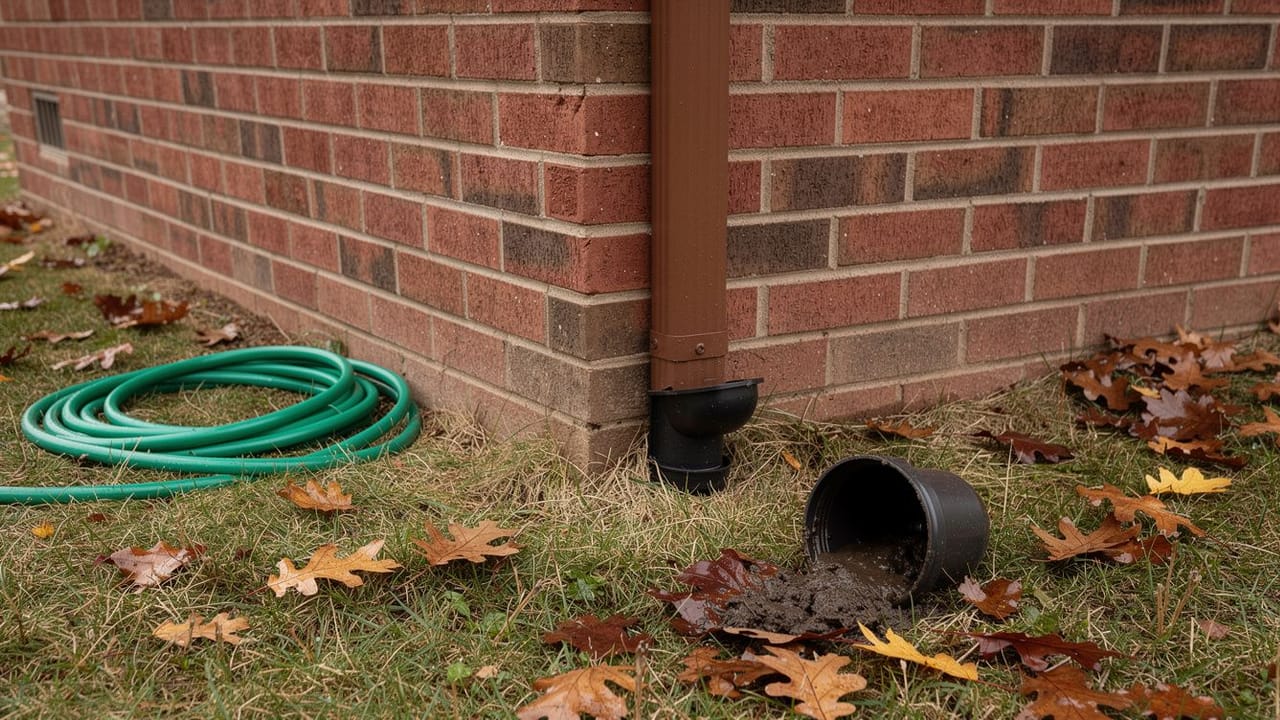
Water leaving a gutter drops through the outlet, turns through one or two elbows to get back against the wall, runs straight down the downspout, and then either turns out onto a splash block or extension or drops into a fitting that feeds a pipe buried in the lawn. The straight runs rarely hold anything. The turns do. The outlet and the first elbow catch the leaves, seed pods and twigs that slide down the gutter, and once a few wedge across the opening, grit and shingle granules pack in behind them. The bottom elbow and the fitting at grade catch whatever made it that far.
A few signs point to the downspout rather than the gutter. The spill happens at the corner nearest the outlet, not along the whole run. Water stands in the gutter at that outlet for a day after the rain stops. Tapping the downspout low and then high sounds dull and heavy at one point and hollow above it. And if the downspout ties into a buried line, water may bubble or spill out at the joint where the downspout meets the ground fitting while the gutter above stays clear. If the gutter overflows across its full length even when the outlet is open, the problem is more likely capacity or pitch, which is a different question we cover in gutters that overflow even when clean.
How a downspout is cleared and flushed
We start at the top. Debris sitting in and over the outlet comes out by hand, and the gutter on either side gets cleared so the next rain does not carry the same load straight back down. Then water goes in at the outlet from a hose. If it runs freely and comes out at the bottom at about the rate it goes in, the downspout is open and the gutter was the clog. If it backs up in the outlet, the jam is in the first elbow or just below it.
An elbow packed tight usually has to come apart. The screws or rivets holding the elbow to the outlet and to the downspout are drilled or backed out, the elbow is cleared and rinsed, and it goes back with new fasteners. Pushing a hose or a rod down through a packed elbow tends to compact the plug further into the bend. For a jam lower in the run, the bottom elbow comes off instead and the downspout is flushed down from the top so the plug drops out at the bottom rather than being forced into the buried pipe.
This is the same order our gutter cleaning service works in: gutter cleared, each outlet checked, each downspout run with water until it flows. A gutter cleaned without that last step can look finished and still spill at the corner on the next storm.
- Clear the outlet and the gutter around it first
- Run a hose in at the top and watch the bottom
- Take a packed elbow apart rather than forcing it
- Disconnect at the ground fitting before testing a buried line
- Flush until the water runs clear, not just until it moves
When the clog is in the pipe under the lawn
If the downspout itself runs free once it is lifted off the ground fitting, the blockage is in the buried line. We run water into that line by itself and watch the outlet, whether that is a pop-up emitter in the yard, an open end on a slope or a curb outlet. No flow, or a slow trickle long after the hose has been running, means the line is restricted. Debris near the inlet can often be pulled or flushed back out. Deeper down, a line can hold leaves that got past a downspout without a strainer, silt carried in with every storm, or a low spot where the pipe has settled and water stands between rains. In our experience, and not from any study we can point to, Middle Tennessee clay and the volume of oak, maple and pine debris here make silted lines common, and flexible corrugated pipe fills faster than smooth-wall pipe because its ridges hold sediment.
A line that is crushed, separated at a joint, full of roots or sagging enough to hold water usually has to be opened and that section replaced. Digging in a Tennessee yard comes with a rule that applies to homeowners as much as contractors. The Tennessee 811 FAQ says to give at least three working days’ notice before you dig, that the request is free, and that private property owners must call too. The utilities or their locators mark the lines, not Tennessee 811 itself, and the FAQ describes a tolerance zone of the width of the buried line plus 24 inches on each side where digging has to be done carefully by hand. A shallow downspout line often runs right across a gas, cable or irrigation line, so we make that request before any shovel goes in.
Where the water should go, and keeping it clear
Clearing a clog is only worth doing if the water then goes somewhere useful. The 2018 International Residential Code, in section R801.3 as published for Tennessee, requires that where expansive or collapsible soils are known to exist, roof water be collected and discharged to the ground at least 5 feet from the foundation walls, or into an approved drainage system. Metro Nashville adopted the 2024 International Codes for plans and applications submitted after July 16, 2025, according to Metro Codes’ announcement of the adoption, so for anything new in Davidson County it is worth checking the current edition with the permit office. Our post on where downspouts should discharge goes into distance and slope in more detail.
The University of Nebraska–Lincoln Extension’s NebGuide G2186 on disconnecting downspouts is written for Nebraska, but its basic advice holds here. It recommends cleaning gutters and downspouts twice a year to cut down on clogs and overflows, extending downspouts at least 5 feet from the foundation, capping or plugging any old pipe that used to carry a downspout into a sanitary or combined sewer, keeping discharge away from every part of a septic system, and grading the ground next to the house to fall away at about 2 percent. On many Middle Tennessee lots, the once-a-year cleaning has to land after the oaks finish dropping, which often runs into December.
If a corner of your gutter spills every time it rains, or a pop-up in the yard never seems to open, we can trace the water from the outlet to where it comes out and tell you which part is blocked before we take anything apart. Homeowners in Nashville and the surrounding counties can ask for that through a free estimate.
Sources
- 2018 International Residential Code as published for Tennessee, Section R801.3 Roof Drainage (UpCodes) — Roof drainage discharged at least 5 feet from foundation walls, or to an approved drainage system, where expansive or collapsible soils are known to exist.
- Metro Nashville Codes, Metro adopts 2024 international building codes — Adoption of the 2024 International Codes for plans and applications submitted after July 16, 2025.
- Tennessee 811, Frequently Asked Questions — Three working days’ notice, homeowners must call, free service, utilities mark lines, tolerance zone of 24 inches either side.
- University of Nebraska–Lincoln Extension, NebGuide G2186, Stormwater Management: Disconnecting Downspouts and Impervious Surfaces (2013) — Twice-yearly cleaning, 5-foot extensions, capping old sewer connections, keeping discharge off septic systems, 2 percent slope away from the building.