
· by Michael Blair, Nashville's Gutters
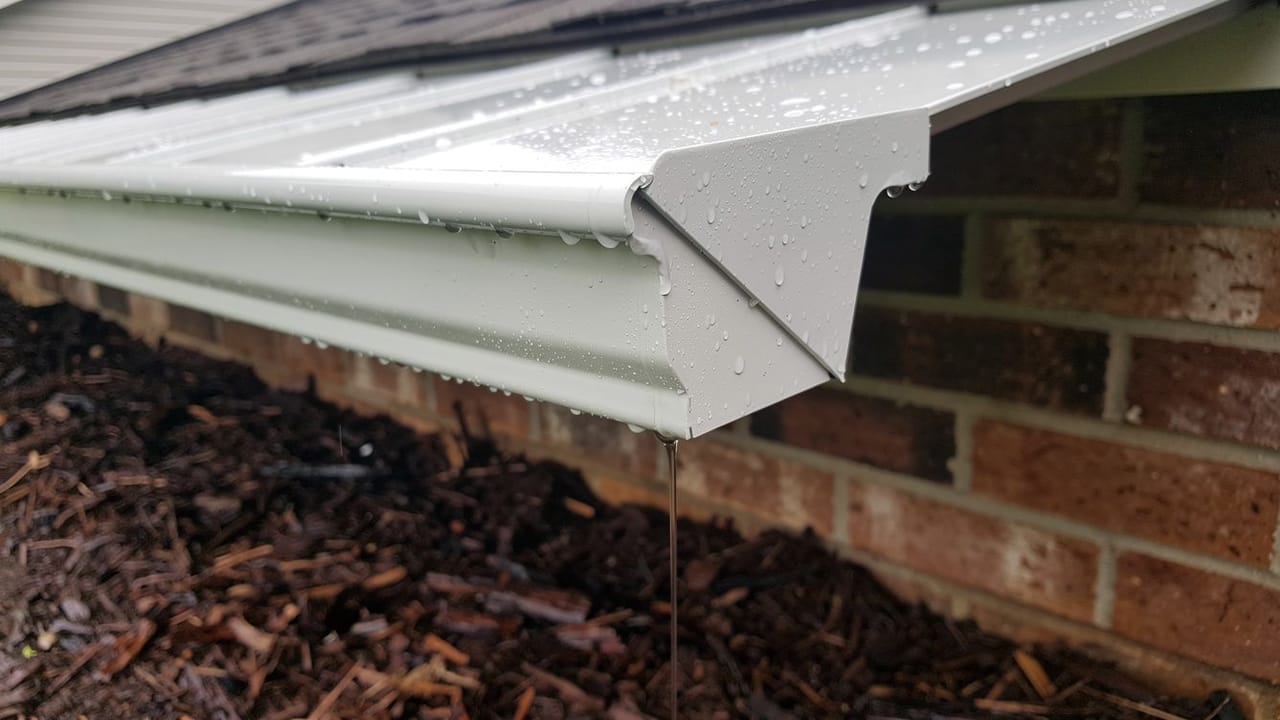
When water runs off a gutter in a steady line from one spot, and the spot is a joint, the trough is usually not the problem. A seam between two lengths, a mitered corner, an end cap or the drop where the downspout leaves has opened, and the sealant that was holding it closed has quit. Smearing more caulk over the drip is the usual fix and the reason the same joint leaks again next spring. A joint that is opened up, cleaned to bare metal and sealed with the right product the right way tends to stay closed, and when it cannot be, the honest answer is a new corner or section. That is most of what our gutter repair service does on hung aluminum gutters.
Why a sealed joint opens
Aluminum grows and shrinks with temperature more than the wood it hangs on, and a gutter run is a long, thin piece of it. Across a Middle Tennessee year the same run sits in full afternoon sun in August and in freezing rain in January, so every joint is worked back and forth through every season. The sealant in that joint has to stretch and recover each time. Once it hardens and loses that give, it either pulls away from one side of the joint or splits down the middle, and water finds the gap on the next rain.
Manufacturers write this into their instructions. Gentek’s aluminum rainware installation guide warns that where the temperature range is large, pop rivets in a run longer than about 20 feet in a straight line may fracture from expansion and contraction, and it suggests a lapped joint bedded in a high-grade silicone sealant that stays elastic as the better choice there. DAP’s page for its Dynaflex gutter and narrow seam sealant tells installers to keep gutter runs under 50 feet for the same reason. Long runs on a sectional system, with a rivet line at each lap, are where seams open first.
How a seam is resealed so it holds
Every gutter sealant data sheet starts in the same place: the old material comes out. The Geocel 2320 and 2321 gutter sealant technical data sheet calls for a clean, dry surface with the old sealant removed, and DAP’s data sheet for its Gutter and Flashing sealant asks for a surface that is clean, dry, structurally sound and free of old caulk, dirt and dust. New sealant laid over old, cracked sealant bonds to the old sealant, not to the metal, and lets go with it. So the joint is scraped and brushed down to bare aluminum, the grit and oxidation wiped off, and the metal left to dry out completely, which after a week of rain can mean waiting for a dry afternoon.
The product has to match the joint. Geocel rates its 2320 and 2321 for aluminum, galvanized and vinyl-clad gutters, end caps and downspouts, and not for a joint wider or deeper than a quarter inch by a quarter inch. A gap bigger than that is a fit problem, and the cure is to close the joint mechanically before sealing it. Cure times differ too: Geocel lists 15 minutes to tack free and five days to full cure, while DAP lists an application range of 20 to 120 degrees, two hours to tack free, one hour before it can take water and 24 hours to full cure. A seal done the afternoon before a storm needs a product rated to take the water.
On a lapped seam, Gentek’s guide spells out the joint: a 2 1/2 inch overlap laid so water runs over the lap rather than into it, two beads of gutter sealant, seven pop rivets between them, and sealant run over the seam and the rivet heads. When we reseal a seam that was built that way, that is what we put back, with the rivets replaced where the old ones have cracked or worked loose.
- Old sealant and loose rivets out, down to bare metal
- Joint dry, clean and free of dust before any sealant goes on
- Sealant rated for aluminum gutters and for the width of the joint
- Lap laid with the flow, beads and rivets per the manufacturer
- Cure time respected before the next rain
Corners, end caps and the downspout drop
A seamless gutter removes the mid-run seams, which is the subject of our post on seamless or sectional gutters, but it still has joints at every corner, every end and every outlet. Corners are inside and outside miters, either formed pieces or cut on site, and Gentek’s instructions call for sealant along the full length of every joint between the gutter and the miter, along every miter seam and over every pop rivet. A corner is also where two runs meet and push against each other as they move, and on most houses it is the low point that carries the water from both sides. When a seamless system leaks at a corner, it usually means the miter was under-sealed when it went up, the seal has aged out, or one run has pulled away and opened the joint.
End caps get a bead of sealant along the whole joint and fasteners through the front, bottom and back, per the same guide. An end cap that drips usually has a gap at the bottom where the bead was thin, or the cap has been knocked loose by a ladder. The downspout drop is the third common spot: the outlet is riveted and sealed into the bottom of the gutter, and when that seal fails the water runs down the outside of the downspout instead of through it, often leaving a stain on the siding or brick below. Each of these is resealed the same way as a seam: old material out, bare dry metal, the right sealant, the fasteners checked.
When to replace instead, and what a drip does to the fascia
Resealing is the right repair when the metal is sound. It is the wrong one when a corner miter is bent or split, an end cap no longer fits snugly, the gap is wider than the sealant is rated to bridge, the aluminum around the rivet holes has torn, or the joint has been caulked so many times that the layers will not come clean. In those cases we replace the corner, the cap or the length of gutter on either side of the joint, because sealant asked to fill a gap the metal should have closed fails within a season. On an older sectional run with joints failing one after another, it can be time to look at one continuous run instead.
The cost of waiting is mostly in the wood. A seam that drips puts water on the same few inches of fascia every rain, and the sealed joint sits tight against the board so it rarely dries out. The USDA Forest Products Laboratory’s study of limiting conditions for decay found that wood will decay above 30 percent moisture content and will not decay below 20 percent, with the range between a grey area. A fascia board behind a leaking corner through a wet Nashville winter and spring can sit well above that line for months. Our post on fascia rot behind the gutter covers what happens once it does, and why the board gets fixed before the gutter goes back on.
If a joint on your house drips every time it rains, we can look at it, tell you whether it reseals or needs a new piece, and check the fascia behind it while we are there. Homeowners in Franklin and across the area can ask for that through a free estimate.
Sources
- Gentek Building Products, Aluminum Soffit, Fascia and Rainware Installation Guide — Lap joint construction, sealing of miters and end caps, and rivet fracture on long runs where temperature swings are large.
- Geocel 2320/2321 Gutter and Narrow Seam Sealant, Technical Data — Suitable substrates, quarter-inch joint limit, clean dry surface with old sealant removed, tack-free and cure times.
- DAP Gutter and Flashing Advanced Sealant, Technical Data Sheet — Application temperature range, tack-free, water-ready and full cure times, surface preparation.
- DAP Dynaflex Gutter and Narrow Seam Sealant product page — Manufacturer advice to keep gutter runs under 50 feet to limit thermal expansion.
- USDA Forest Products Laboratory, Morris and Winandy, Limiting Conditions for Decay in Wood Systems (2002) — Wood decays above 30 percent moisture content and not below 20 percent.