
· by Michael Blair, Nashville's Gutters
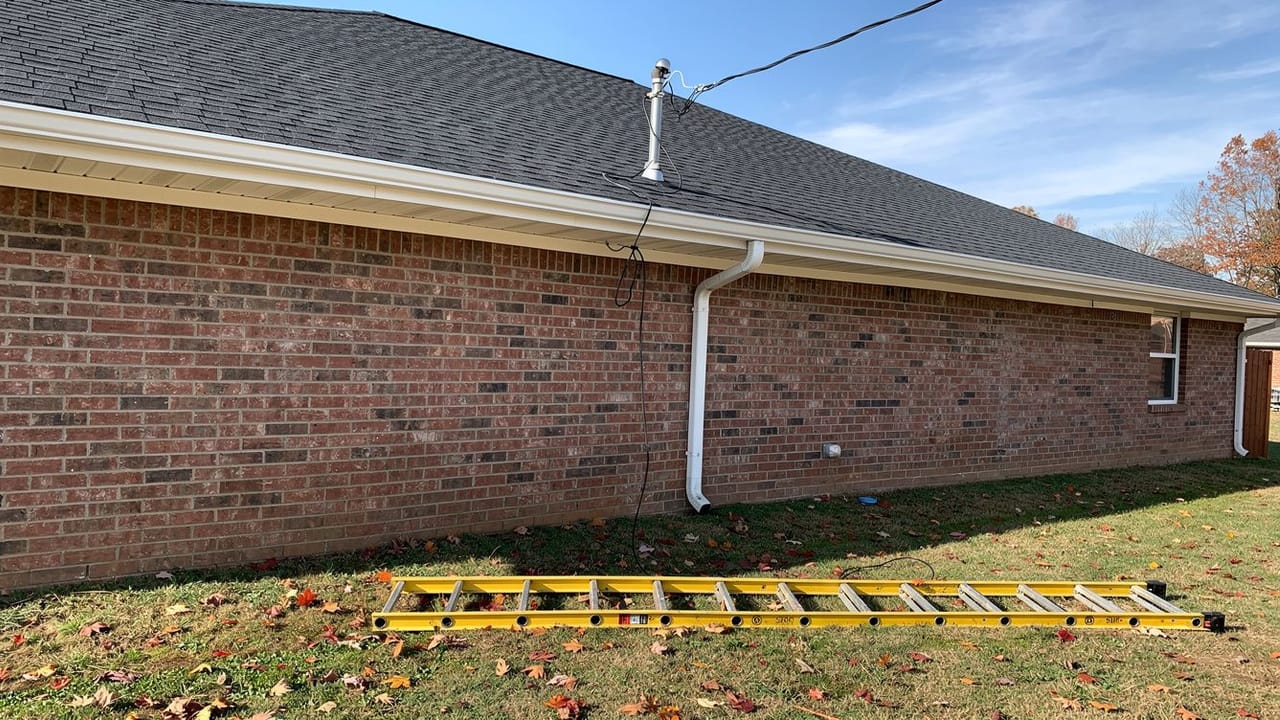
Cleaning gutters is ladder work along the roofline, and every house has at least one overhead wire that comes to it there: the service line running in from the street. Leaves and a fall are what most people think about. The wire is the hazard that is easy to forget until a ladder is swinging toward it. Here is why that line matters, how far a ladder has to stay from it, what the ladder should be made of, and how our crews set one up along a gutter run. When the wire is close to the gutter, or the house is two stories, it is a job for our gutter cleaning service.
Why is the wire to the house a hazard during gutter cleaning?
The wire to the house is a hazard during gutter cleaning because it is live and often not insulated against contact. The Consumer Product Safety Commission’s publication Ladders and Electricity Don’t Mix, revised in 2012 and still offered on its site, names cleaning gutters among the jobs that bring a ladder near overhead wires. It says many overhead power lines are not insulated, that any line, including the one from the street to your house, can carry current into metal or a wet branch that touches it, and that the coating on a line is not meant to keep anyone from being electrocuted.
The CPSC’s advice is to treat every overhead wire as live. The same publication counts 15 electrocution deaths outside of work from 2000 to 2009 in which a ladder around a home touched an electrical wire. That count is more than a decade old, but the hazard it describes has not changed. Wherever the service line comes in, we note where it meets the house before the ladder comes off the truck.
How far does a ladder need to stay from an overhead line?
A ladder needs to stay at least twice its own length from the nearest overhead line, by the CPSC’s count. For a 24-foot extension ladder that is 48 feet, which on a lot of houses rules out the stretch of gutter nearest where the service line comes in. The distance accounts for a ladder that tips or swings while it is being raised, carried or lowered, not only for one standing still against the wall.
The same publication adds three rules that matter along a roofline. Never work on a windy day. Set the ladder on level, solid ground, with a flat piece of wood under a foot where the ground is soft or uneven, and tie it off if you can. And if a ladder starts to fall toward a power line, let go of it rather than try to save it. Where a section of gutter cannot be reached while keeping that distance, we clean it from a position that does not put the ladder in the line’s reach, or we tell you plainly that the utility has to be involved first.
Does the ladder material matter near a power line?
The ladder material matters near a power line because a ladder that conducts gives current a path. Near overhead wires, the CPSC recommends a nonconducting ladder, for example a fiberglass one whose side rails are nonconductive. Aluminum extension ladders are common in garages because they are light, and that is exactly the ladder the advice steers people away from near a service line.
Professional crews are held to the same idea. The federal ladder standard for construction work, 29 CFR 1926.1053, requires nonconductive side rails where a worker or the ladder could contact exposed energized electrical equipment. It is an OSHA rule for employers, not a law that applies to a homeowner on their own ladder, but it is the standard we hold our crews to. Fiberglass does not make a wire safe to touch; a wet rail or a wet branch can still carry current, which is why the distance comes first and the material second.
Setting the ladder for a gutter run
Setting the ladder for a gutter run starts with the angle. OSHA’s ladder standard sets the foot of a leaning ladder about one quarter of its working length out from the top support, so a ladder reaching 16 feet up the wall stands about 4 feet out. Getting that angle right comes before anyone climbs, and it is checked again each time the ladder moves along the eave.
The same standard lists rules our crews follow on every run: the ladder stands on a stable, level surface or is secured; it is not moved, shifted or extended while anyone is on it; the person on it faces the ladder and keeps at least one hand on it; and nobody carries anything that could pull them off balance. That last one is why our crews hang a bucket instead of climbing with an armful of leaves.
When and how often to clean are in our post on cleaning gutters in Middle Tennessee. We clean gutters in Franklin and across Williamson County, Nashville and the towns around them; if a line runs close to yours, ask us for a free estimate and we will look at it before we quote.
Sources
- U.S. Consumer Product Safety Commission, Ladders and Electricity Don’t Mix, Publication 5060 (revised April 2012) — Ladders near overhead wires when cleaning gutters; many lines not insulated; any line including the one to the house can carry current; assume all wires are live; 15 non-work deaths 2000 to 2009; nonconductive ladders; twice the ladder length from lines; no windy days; level ground; let a falling ladder go.
- OSHA, 29 CFR 1926.1053, Ladders (construction standard, eCFR) — An employer standard for construction work, not a rule on homeowners: one-quarter working length angle; stable, level surfaces; no moving an occupied ladder; face the ladder, one hand on it, no load that unbalances; nonconductive side rails near exposed energized equipment.
FAQ
Cleaning Gutters Near Power Lines: Ladder Rules — questions
Is it safe to clean gutters near a power line?
Only with distance. The CPSC says to assume every overhead wire is live, including the one from the street to your house, and to keep a ladder at least twice its own length from the nearest line. If a gutter section cannot be reached that way, leave it to a crew who can plan around the wire.
Can you use an aluminum ladder near power lines?
The CPSC advises against it. Near overhead wires it recommends a nonconducting ladder, for example fiberglass with nonconductive side rails, and OSHA requires nonconductive rails for workers who could contact energized equipment. Fiberglass still does not make contact safe, so keep the distance from the line as well.
How far should a ladder sit from the house when cleaning gutters?
About one quarter of the ladder’s working length. OSHA’s ladder standard for construction work sets the foot of a leaning ladder at roughly that distance from its top support, so a ladder reaching 16 feet up stands about 4 feet out. Set it on level, solid ground and never move it while standing on it.
What is the safest way to clean gutters on a two-story house?
With a fiberglass ladder set at about a one-in-four angle on firm ground, on a calm day, kept at least twice its length from any overhead line, facing the ladder with a hand on it and a bucket hung rather than carried. Where the service line sits near the gutter, hire a crew.
What should you do if a ladder starts to fall toward a power line?
Let it go. The CPSC’s advice is to release a ladder that begins falling toward a power line rather than try to hold it. Treat the line as live, keep everyone clear of the ladder where it lands, and do not set it back up near that wire. Plan the rest of the job from farther away.