
· by Michael Blair, Nashville's Gutters
Some houses go years without gutters, and their owners reasonably ask whether they need them at all, especially on a house with deep eaves or a roof that seems to shed water onto the lawn well enough. The honest answer depends on the ground under the house, the foundation, and how far the roof edge reaches past the walls. Here is what the residential code says, what building research says happens when roof water has nowhere controlled to go, and what the alternatives look like when gutters are not the answer.
Does the building code require gutters on a house?
The residential code does not require gutters by name, but it does require a controlled way to carry roof water away from the foundation wherever expansive or collapsible soils are known to exist. Section R801.3 of the International Residential Code, as published for Tennessee, says such a house must collect its roof drainage and discharge it at least 5 feet from the foundation walls, or into an approved drainage system. In practice, that controlled method is nearly always gutters and downspouts.
Whether a particular lot counts is a local question. Section R401.4 leaves it to the building official to decide whether a soil test is needed where the available data point to expansive or shifting soils. Separately, Section R401.3 requires the ground to fall at least 6 inches in the first 10 feet away from the foundation, which matters for any roof water that lands near the wall.
Much of the ground around Nashville is clay, and we treat a house here as though the rule applies, because ground that swells when it is wet is exactly what the rule was written for.
What happens to a house without gutters?
Without gutters, the water from the whole roof lands in a line along the foundation, and over time it saturates the soil there and works its way into a crawl space or basement. The Building America Solution Center’s gutters and downspouts guide notes that a few inches of rain on a roof can produce several thousand gallons of runoff, enough to soak the soil around a house quickly and wick through the foundation, where it can lead to mold and rot inside.
The guide singles out expansive and collapsible soils. Expansive soil swells when it gets wet and can press on a foundation hard enough to crack it; collapsible soil settles when wet. Either way, the wet ground beside the wall can sink into a trough that holds water against the foundation.
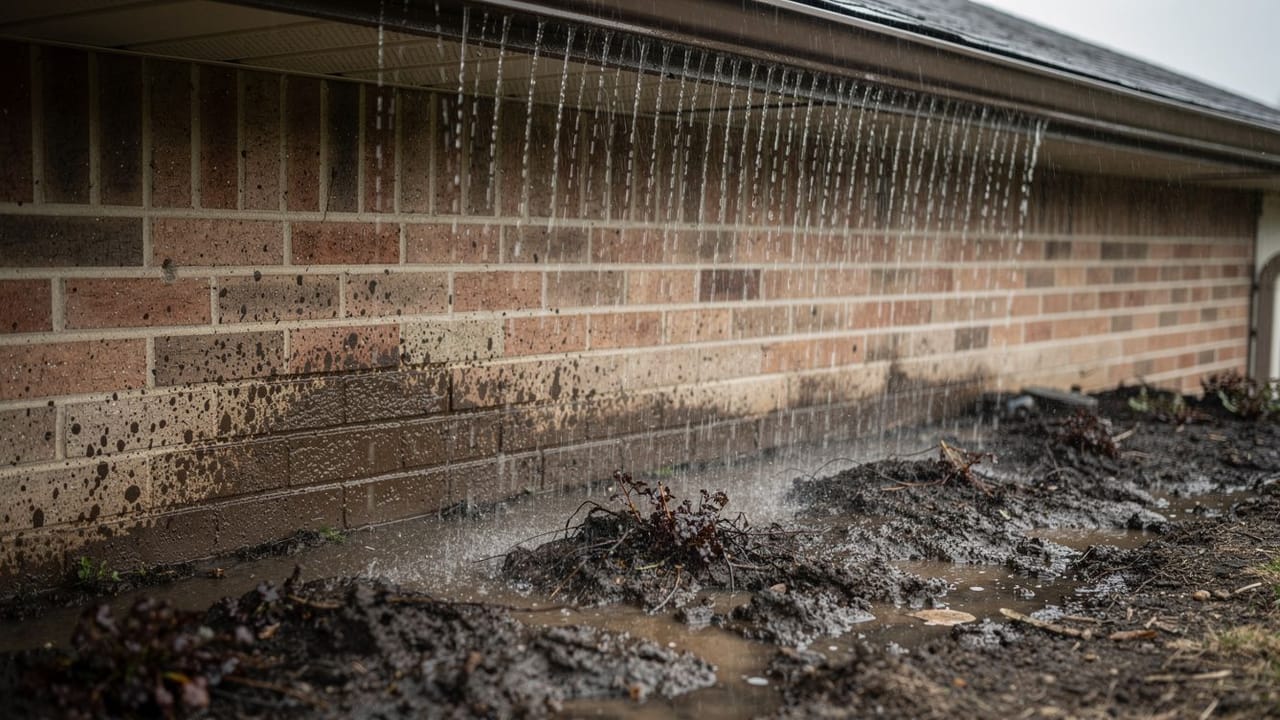
There is a visible cost as well. Rain dropping off an eave with no gutter splashes mud and water back onto the lowest siding or brick and the top of the foundation, and wears a groove into the bed below the drip line.
Can a house do without gutters?
A house can do without gutters only if its roof water is handled some other way, and the alternatives ask more of the house than most owners expect. The Building America guide says gutters or another drainage system are needed in all but the driest climates in the country. Its alternative to gutters is a gravel bed at grade around the house, over a lined trench with a drain pipe that carries the water to ground sloping away at least 5 feet out, to a dry well, or to another approved outlet.
A house without gutters also needs protection from splash-back. Following the EPA’s Indoor airPLUS program, the guide gives three ways to get it: foundation walls that stand at least 16 inches above the finished grade; overhangs that put the drip line at least 16 inches out from the foundation wall, with siding kept at least 8 inches above the ground; or cladding that tolerates regular wetting, such as brick or stone, over a sealed drainage plane reaching at least 16 inches above grade.
ENERGY STAR, the guide notes, does not require gutters on homes with a slab-on-grade foundation or in a dry climate. Middle Tennessee is not dry, and many houses here sit over crawl spaces or basements, so those exceptions rarely fit.
Getting gutters that actually move the water
Gutters only do their job if they are pitched, drained and discharged properly. The Building America guide asks for gutters sloped at least 1/16 inch per foot toward the downspouts, downspouts every 20 to 50 feet along the run, and discharge at least 5 feet from the foundation or into an underground system at least 10 feet away. It also notes that K-style and half-round gutters perform about the same; the difference between them is looks.
For a house that has never had gutters, we start with the roof: how many slopes drain to each eave, where downspouts can go, and where the water can run once it reaches the ground. Our seamless gutter installation page covers the gutter itself, downspouts and drainage covers the other end, and where your downspouts should discharge goes into the ground side. We do this work across Middle Tennessee, from Lebanon to Franklin. To talk through a house without gutters, request an estimate.
Sources
- 2018 International Residential Code as published for Tennessee, Section R801.3 Roof Drainage (UpCodes) — Where expansive or collapsible soils are known, roof drainage collected and discharged at least 5 feet from foundation walls or to an approved drainage system.
- 2018 International Residential Code as published for Tennessee, Sections R401.3 and R401.4 (UpCodes) — Grade falls 6 inches in the first 10 feet; the building official decides whether a soil test is required where expansive soils are likely.
- Building America Solution Center, Gutters and Downspouts — Runoff volume from a roof; effects on expansive and collapsible soils; gutters needed in all but the driest climates; no-gutter alternatives and splash protection; ENERGY STAR exceptions; 1/16 inch per foot slope; downspouts every 20 to 50 feet; 5- and 10-foot discharge.
FAQ
Does a House Need Gutters in Middle Tennessee? — questions
Do I really need gutters on my house?
On most Middle Tennessee houses, yes. Building America guidance says gutters or another roof drainage system are needed in all but the driest climates, and the residential code requires controlled roof drainage wherever expansive soils are known. A house can skip gutters only with tall foundation walls, 16-inch drip lines or a drained gravel bed at grade.
Are gutters required by code in Tennessee?
Not by name. Section R801.3 of the International Residential Code, as published for Tennessee, requires a controlled method of collecting roof water and discharging it at least 5 feet from the foundation where expansive or collapsible soils are known to exist. Gutters and downspouts are the usual way to meet it, and the building official decides on the soil.
Is having a house without gutters a bad idea?
Usually, unless the house was designed for it. Without gutters, roof water lands along the foundation, saturates the soil and can wick into a crawl space or basement, and splash-back wets the lowest siding. A house built with tall foundation walls, 16-inch drip lines or a drained gravel bed at grade can manage without them.
Why do houses need gutters?
To keep the roof’s water away from the foundation. The Building America Solution Center notes that a few inches of rain on a roof can produce several thousand gallons of runoff. Collected and carried 5 feet or more from the walls, that water drains away instead of soaking the soil beside the foundation.
Do you need gutters on a house with a crawl space?
In practice, yes. Roof water dumped along the foundation soaks the soil right beside the wall, the same soil a crawl space draws its moisture from. The ENERGY STAR exception for skipping gutters covers slab-on-grade homes and dry climates, and neither describes a crawl space house in Middle Tennessee.