
· by Michael Blair, Nashville's Gutters
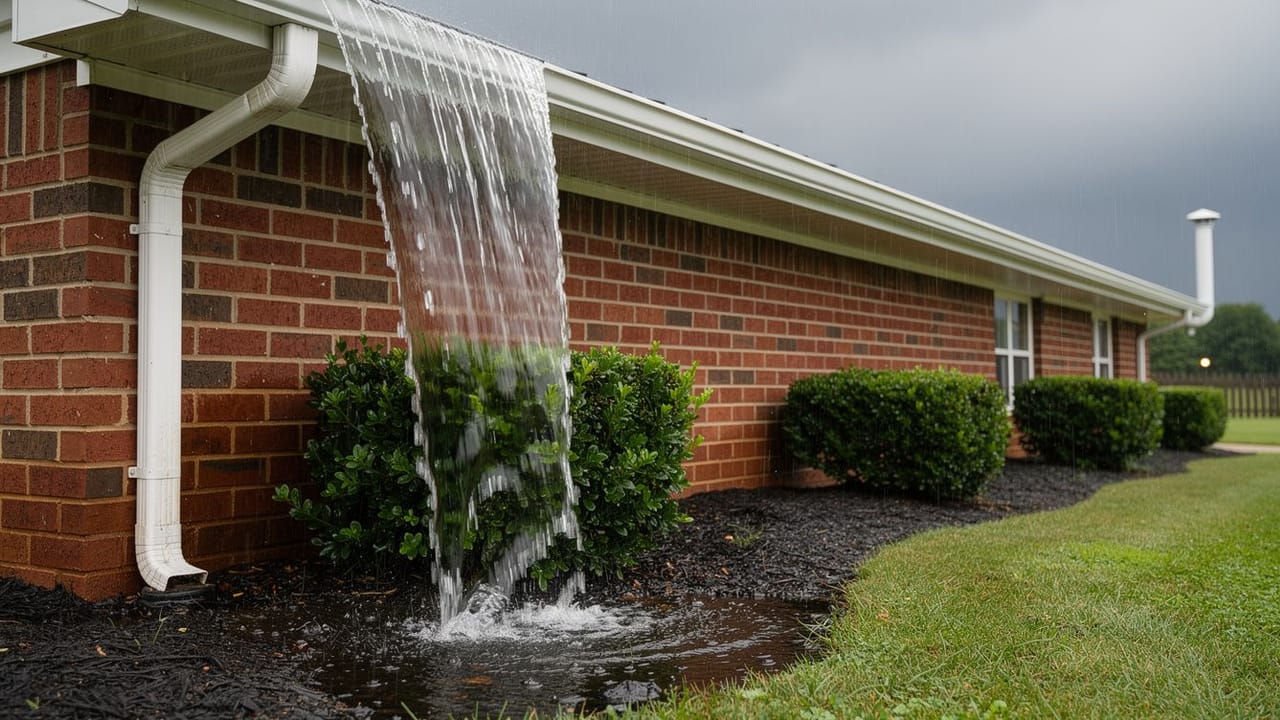
Overflow gets blamed on leaves, and leaves are often innocent. Rain here can come down very hard for a few minutes at a time: in NOAA’s Atlas 14 rainfall frequency figures for downtown Nashville, the five-minute burst expected about once every ten years falls at a rate of 6.85 inches an hour, while an hour-long downpour of the kind that comes around once a year averages 1.30. A gutter that copes with an ordinary shower can be swamped by that burst with nothing in it at all.
Why does a clean gutter overflow?
A gutter only carries water as far as its nearest outlet, so the number of downspouts sets its limit as much as the trough does. The Department of Energy’s Building America Solution Center guide to gutters and downspouts says the more closely downspouts are spaced, the more water the system moves during peak rainstorms, and it allows 1 square inch of downspout cross-section for every 100 square feet of roof. A big roof area draining to one outlet is the first thing we look for when a clean gutter overflows.
Upsizing to six-inch gutter only helps if the outlets keep up. The same guide says a larger size conducts more water at a faster rate provided there are enough downspouts to drain it, and it treats the style of the gutter as mostly a matter of looks. So before we price a bigger gutter we count the outlets, and adding a downspout is the first option we look at. The wider sizing question, roof area and all, is in our post on sizing gutters for a Nashville downpour.
Pitch and hanger spacing
A gutter also needs fall toward its outlet. The Solution Center guide calls for a slope of at least 1/16 inch per foot of run, which works out to about 5/8 inch over ten feet. A run that was hung flat, or has settled back the wrong way, holds water between storms.
Hangers are the other half of it. On any run that overflows we sight along the gutter from the end, because a stretch that sags between its hangers makes its own low spot. Resetting hangers and re-pitching a run is gutter repair work, and it is usually checked before anyone talks about new gutter.
- Count downspouts against roof area, about 1 square inch of outlet per 100 square feet
- Check fall toward the outlet, at least 1/16 inch per foot
- Sight along the run for sags between hangers
- Check that a drip edge is there at the roof edge
- Watch the gutter below each valley in a hard rain
Why would water run behind a gutter that is clean?
When water runs down the fascia behind a gutter that is perfectly clean, we look at the roof edge before anything else. The Solution Center guide says to check whether a metal drip edge is installed or included as part of the gutter, since some metal gutters have an integral flashing piece that does the same job, and to install one where it is missing. Water that keeps finding its way behind the gutter ends up in the wood, and our post on fascia rot behind the gutter covers what that leads to.
Valleys are the other place to look. Where two roof slopes meet, both drain into the same short stretch of gutter, and that stretch is worth standing under in a hard rain. If water overshoots there while the rest of the run copes, the fix belongs at that one spot.
What overflow costs
Water spilling over the front of a gutter lands in a line along the foundation, which is the one place roof water is not supposed to end up. The Solution Center guide has gutters and downspouts terminate at least 5 feet away from foundations, or feed an underground catchment system at least 10 feet away.
Overflow bypasses all of that, however well the downspouts themselves are piped. The piping side is covered in our post on where downspouts should discharge. If a run spills over in every hard storm, ask us for a free estimate and we will look at the outlets, the fall and the roof edge together.
Sources
- U.S. Department of Energy, Building America Solution Center: Gutters and Downspouts — Downspout spacing and capacity during peak storms; 1 sq in of downspout per 100 sq ft of roof; larger gutters need enough downspouts; style mainly aesthetic; slope at least 1/16 inch per foot; drip edge or integral flashing; discharge 5 feet from foundations, 10 feet for underground catchment; more capacity where rain is heavy
- NOAA National Weather Service, Atlas 14 Volume 2 point precipitation frequency estimates (intensity), downtown Nashville — 10-year, 5-minute intensity 6.85 inches per hour; 1-year, 60-minute intensity 1.30 inches per hour
FAQ
Gutters That Overflow Even When Clean — questions
How many downspouts do I need?
It depends on roof area and gutter size. The Department of Energy’s Building America Solution Center guide places downspouts every 20 to 50 feet along the gutter, allows 1 square inch of downspout cross-section for every 100 square feet of roof, and says to increase gutter and downspout capacity in areas with heavy rain. Where a large roof area or a valley drains into one section, we count that section on its own.
Are six-inch gutters worth the upgrade?
Sometimes. A larger gutter carries more water, but only when there are enough downspouts to drain it, so a run that overflows because one outlet serves a big roof may be fixed by adding a downspout and leaving the gutter alone. Where the downspouts are already adequate for the roof area and the run still overflows in hard storms, a larger gutter with larger downspouts is the next step.
Why does water run behind my gutter?
The first things to check are whether there is a drip edge at the roof edge and whether the gutter has pulled away from the fascia. A drip edge, or the flashing built into some metal gutters, belongs on the roof edge, and one should be added where it is missing. Either way, cleaning will not help, because the problem is in how the roof edge and the gutter meet.
How much fall should a gutter have?
At least 1/16 inch per foot of run toward the outlet, per the Department of Energy’s Building America guide, which comes to about 5/8 inch over ten feet. A run hung flat or settled back the wrong way holds water between storms, so we also sight along it for sags between hangers.