
· Michael Blair
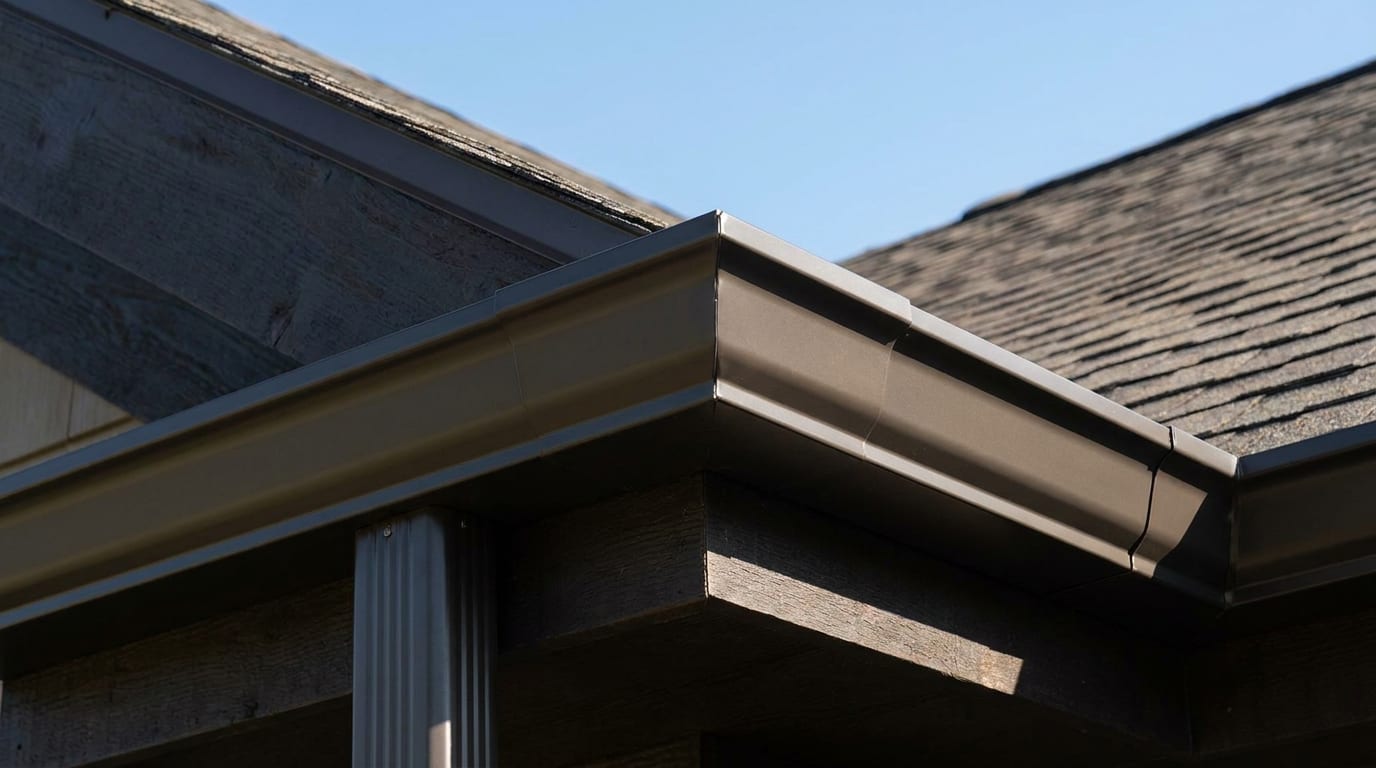
Gutters fail at the joints. A sectional gutter, the kind sold in ten-foot lengths at the home center, has a joint every ten feet plus every corner and every outlet, each sealed with a connector and sealant that dries, shrinks and lets go. A seamless gutter is extruded on site from a coil of aluminum, run the full length of the eave in one piece, and joined only at corners and downspout outlets. That single difference is why seamless has become standard on Nashville houses, and it is also why the remaining joints deserve more attention than they usually get.
Where sectional gutters leak
The slip joints and seam connectors on sectional gutters rely on sealant, and sealant on a surface that expands and contracts through our summers and winters fails within a few years. The first sign is a drip line in the mulch below a joint. The next is the fascia behind it going soft, because a slow drip at a seam hits the same spot for years.
Sectional gutters are also hung by the homeowner or the handyman more often than by a gutter company, and the slope, hanger spacing and outlet placement suffer for it. A run that is pitched wrong holds water at every joint, which is where it leaks.
What seamless gets right, and what it does not
One piece per run means no mid-run joints at all. The aluminum coil is heavier gauge than most sectional product, the profile is consistent, and the machine forms it to the exact length of the eave. Hidden hangers screwed into the fascia at close spacing carry it without the spikes that work loose over time. It is installed by a crew that does it daily, which is the bigger part of the difference.
The joints that remain are corners, end caps and outlets. Corners are mitered on site and sealed, and a badly cut or under-sealed miter leaks just as a sectional joint does. Ask how corners are done: a box miter or a well-sealed strip miter, sealed inside with a quality gutter sealant, is the standard. Outlets should be a proper flanged drop, not a hole with a downspout pushed in.
- Mid-run joints: none on seamless, every ten feet on sectional
- Corners and outlets: sealed on both, and the weak point on both
- Hangers: hidden screw hangers at close spacing, not spikes
- Gauge: heavier aluminum on seamless as a rule
Where sectional still makes sense
A short run on a shed or a detached garage, a repair to a single damaged section on a house that already has sectional gutters, or a run under a few feet where a truck-mounted machine cannot reach: sectional is fine and cheaper for those. Vinyl sectional gutters are the budget end and the one to avoid on a house; they sag between hangers in heat, become brittle in cold, and the joints fail fastest of all.
Copper and steel gutters are also sectional by nature, joined with soldered or crimped seams, and those joints are far more durable than sealant. On a historic house with half-round copper, sectional is the correct answer.
What to check on a seamless quote
The size. Most houses here take a five-inch K-style gutter; a large or steep roof, or a long run to a single downspout, wants six-inch. The downspout count and where they discharge matter more than the gutter, because an undersized or badly placed downspout overflows a perfect gutter in a Nashville thunderstorm. And the fascia: a gutter hung on rotten fascia holds for a season. Any soft wood behind the old gutter should be replaced before the new one goes up, and a good gutter company will say so.
Get the gauge in writing, ask about the hanger spacing, and ask what happens at the corners. Those three answers separate a seamless job that lasts decades from one that drips in five years.