
· by Michael Blair, Nashville's Gutters
A rain barrel looks like an add-on, but it changes the end of a gutter system. The downspout that used to carry a stretch of roof away from the house now fills a 55-gallon drum beside the wall, and in a Nashville downpour that drum fills fast. How it is connected decides where the rest of the water goes. Here is how we hook a barrel to a downspout, where the overflow belongs, what keeps it from breeding mosquitoes, and what the barrel and the downspout need before the first frost.
Should you cut the downspout or use a diverter?
For most houses we fit a diverter rather than cutting the downspout down to the barrel, because a diverter sends water back down the downspout once the barrel is full. Virginia Cooperative Extension’s rain barrel fact sheet (SPES-10P) gives a diverter hose two advantages: the downspout stays whole, and the barrel can be shifted a little for access. It notes that most diverters close as the barrel fills, so runoff bypasses it and keeps flowing out the downspout, and that a barrel on a diverter may not need an overflow hole.
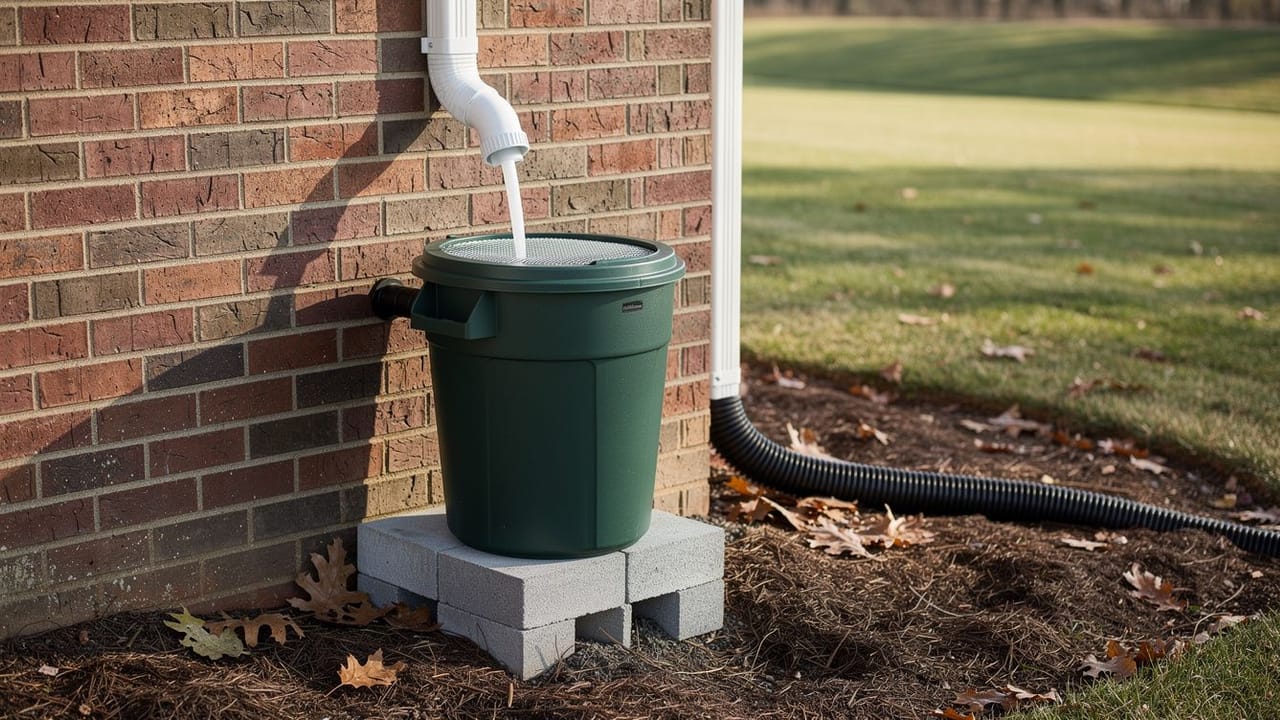
Cutting the downspout so it empties into the barrel top is simpler, and it is how the University of Tennessee Extension’s W276, Rain Barrels Make Good Sense, builds one, with a strainer in a flexible spout. The catch is that everything that stretch of roof sends now arrives at the barrel, and whatever the barrel cannot hold leaves through its overflow, right beside the wall.
Either way, the barrel is only as good as the gutter above it. A clogged gutter spills over before the barrel sees water, and leaves that reach the downspout block the strainer or the diverter, which is why gutter cleaning comes before a barrel goes in.
Where does the overflow go when the rain barrel is full?
The overflow has to go into the lawn or a planting bed, away from the foundation, the same place the downspout’s water went before. The numbers explain why. W276 notes that one inch of rain on a 1,000-square-foot roof can produce up to 623 gallons, enough to fill more than ten 55-gallon barrels. A barrel catches the start of a storm, and the rest of it still needs a path.
On a cut-in barrel, that means a hose or pipe from the overflow fitting carried out to where the old downspout extension ended, not an opening that spills at the wall. UT’s guidance is to send excess water into the lawn or a bed, away from the foundation, and to leave a hose on the open spigot while you are away so the barrel drains slowly instead of overflowing. Our post on where downspouts should discharge explains the distance we aim for, and our downspouts and drainage page covers the extensions and buried lines we run.
The barrel also needs a base that will not move. W276 puts a full 55-gallon barrel at about 460 pounds and asks for a level, raised base of concrete blocks or composite lumber, noting that untreated wood may rot. A barrel that settles and tips can take a cut-in downspout with it.
Do rain barrels breed mosquitoes?
Rain barrels breed mosquitoes only when water sits in an open barrel, so a screened top and regular use prevent it. The Virginia fact sheet warns that water left standing more than seven days can become a breeding site, and it recommends covering any openings, the top especially, with fine mesh such as window screen, or using a larvicide based on Bacillus thuringiensis. UT recommends the same bacterium, sold as dunks or granules, and says it is harmless to pets, birds and people.
The water is for the garden, not the kitchen. UT says barrel water carries bacteria and is not for human consumption, and that vegetables watered with it should be washed well before eating. It also says to disconnect the barrel when the roof or siding is cleaned with soap or chemicals, worth remembering on the day the house is washed.
What does a rain barrel need before the first frost?
Before the first frost a rain barrel should be drained and cleaned, then stored or left empty with its spigot open, and the downspout has to be restored so the roof drains away from the house all winter. Metro Water Services’ rain barrel page says to stop using the barrel before the first frost, empty it, clean it with mild dish soap and store it upside down. The Virginia fact sheet adds that where winters freeze, a barrel left outside should be drained with its spigot open so ice cannot crack it.
The step people skip is the downspout. A diverter can be switched to bypass, and the downspout carries on as before. A cut downspout ends a foot or two above the ground once the barrel comes away, and every winter rain then lands against the foundation. We fit a removable section or an elbow and extension, so the downspout can be put back in a minute. UT also asks for the strainer to be checked regularly and the inside of the barrel inspected each fall and spring. If you want a barrel on a downspout at your house in Green Hills or anywhere else we work, ask us for a visit.
Sources
- University of Tennessee Extension, W276: Rain Barrels Make Good Sense — Up to 623 gallons per inch of rain on 1,000 square feet of roof; full 55-gallon barrel about 460 pounds on a level block base; overflow into lawn or beds away from the foundation; strainer and seasonal inspection; drain for winter; Bti for mosquitoes; water not for human consumption.
- Virginia Cooperative Extension, Stormwater Management for Homeowners Fact Sheet 2: Rain Barrels (SPES-10P, 2024) — Diverter hose keeps the downspout whole; most diverters close when the barrel is full; water standing over seven days can breed mosquitoes, screen openings or use Bt; drain and leave spigots open where winters freeze.
- Metro Water Services, Rain Barrels — Discontinue use before the first frost, empty, clean with mild dish soap and store upside down.
FAQ
Rain Barrel on a Downspout: Diverter or Cut-In — questions
How much water does a roof send to a rain barrel?
More than people expect. UT Extension’s W276 says one inch of rain on a 1,000-square-foot roof can produce up to 623 gallons, more than ten 55-gallon barrels. It figures a quarter of that roof sends about 70 gallons in a half-inch rain, more than one barrel holds, so the overflow always needs a path.
Can rain barrel water go on a vegetable garden?
Yes, with care. UT Extension says barrel water contains bacteria and is not for drinking, and that vegetables watered with it should be washed well before they are eaten. Disconnect the barrel while the roof or siding is being cleaned with soap or chemicals, so that runoff does not end up on the garden.
How heavy is a full rain barrel?
Filled to the top, a 55-gallon barrel weighs about 460 pounds, according to UT Extension. That is why it needs a level, firm base, such as concrete blocks or composite lumber, rather than soft soil or untreated wood, which can rot. A raised barrel that settles and tips can pull the downspout connection down with it.
Can you leave a rain barrel outside in the winter?
You can, if it is empty. UT Extension says barrels can stay outdoors once drained, and Virginia Cooperative Extension recommends leaving the spigot open so freezing water cannot crack the barrel. Metro Water Services suggests emptying, cleaning and storing it upside down before the first frost. Either way, put the downspout back.
Does a rain barrel need an overflow if it has a diverter?
Often not. Virginia Cooperative Extension notes that most diverters close when the barrel is full, sending runoff on down the downspout, so an overflow hole may not be needed. A barrel fed by a cut downspout always needs one, with a hose carrying the excess into the lawn, away from the foundation.