
· by Michael Blair, Nashville's Gutters
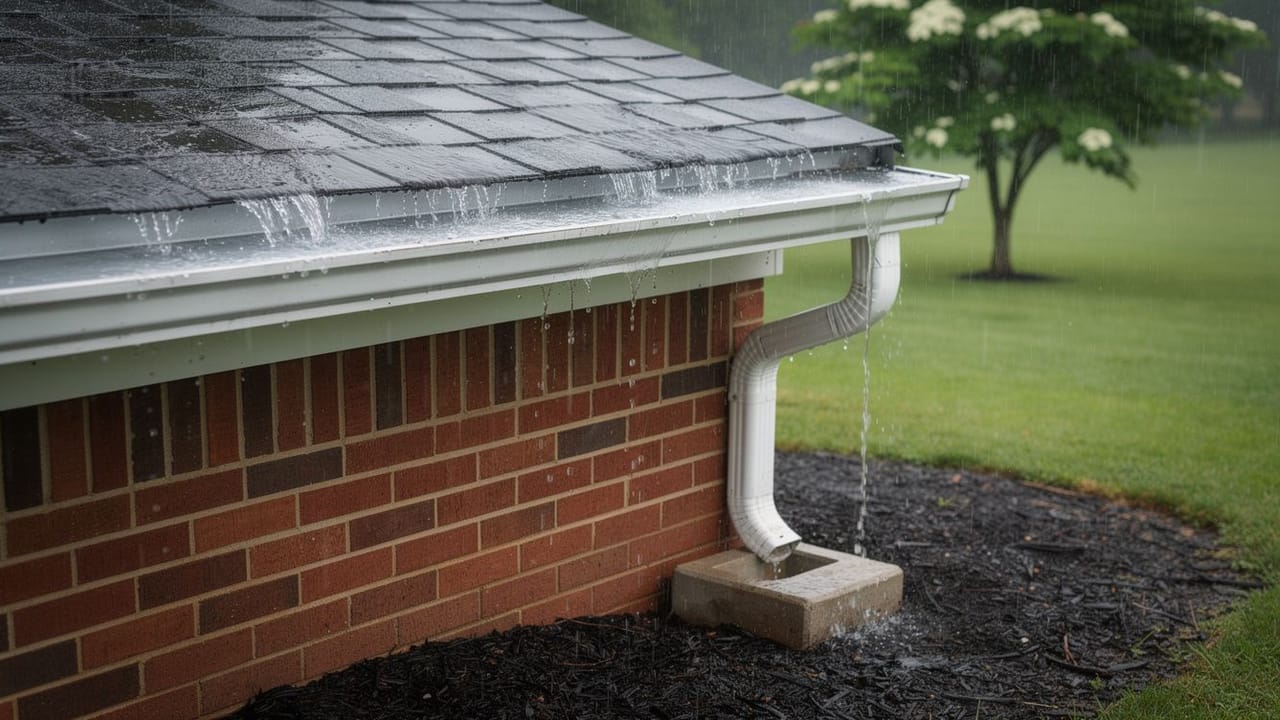
The International Plumbing Code sizes a gutter by the roof area that drains into it and the rainfall rate it has to carry, and its storm drainage chapter takes that rate from the 100-year hourly rainfall or from approved local weather data. Nashville’s rain comes hardest in short bursts, as NOAA’s figures below show. A gutter that keeps up with a spring shower can spill in a July thunderstorm, and on a large roof a five-inch gutter can simply be too small for the water arriving.
What decides how big a gutter needs to be?
The code table for gutters takes three inputs: the roof area draining into the run, measured as its horizontal footprint seen from above rather than the sloped surface; the rainfall rate; and the slope of the gutter itself. Roof pitch is not one of them, so a steep roof and a shallow one over the same footprint come out the same. The one addition the 2009 edition makes is for a wall that sheds rain onto the roof, such as a second story rising above a porch: half that wall’s area is added when the downspouts and drain piping are sized.
For the rate, NOAA’s precipitation frequency data for downtown Nashville gives 3.13 inches per hour for the 100-year, one-hour storm and 2.18 for the 10-year. Inside that hour the worst five minutes run far harder, at 8.88 inches per hour in the 100-year storm. Those figures come from NOAA Atlas 14, Volume 2, the volume that covers Tennessee, published in 2004 and revised in 2006.
Put the two together and the trouble with a five-inch gutter shows. In the 2009 table for half-round gutters at a sixteenth of an inch of fall per foot, a five-inch gutter serves 2,500 square feet of roof at one inch per hour and 834 square feet at three. A six-inch gutter at the same slope and rate serves 1,280. The table is written for half-round profiles, so on a K-style run we read it as a guide to the proportions and check the manufacturer’s capacity figures for the gutter we are hanging, which for a new run is usually seamless aluminum formed on site.
The edition matters. Metro Nashville signed the 2024 International Codes into law on July 16, 2025, and Metro Codes’ news release says they govern plans and applications submitted from that date. The 2024 International Plumbing Code is on Metro’s adopted codes list, and its tables may not match the 2009 figures quoted here, so permitted work should be checked against the current book.
Downspouts matter as much as gutter width
A gutter only holds water on its way to an outlet. The code sizes downspouts against roof footprint in a table of their own, the same way it sizes gutters, so a run can be limited by its outlets just as easily as by its trough. When a long run drains to one downspout, the far end is where we look first.
In the 2009 downspout table, at three inches per hour, a two by three inch downspout is rated for 1,840 square feet of roof and a three by four for 4,400, more than twice as much. The bigger opening is also less likely to jam on the leaves and seed pods that slip past the gutter, in our experience. On a house that keeps spilling, we price an extra downspout before new gutters, because it adds outlet capacity without taking the run down, and that work sits under our downspouts and drainage service.
- Six-inch gutter with three by four downspouts adds capacity on both counts
- Downspouts placed by the roof area each one drains, not by a fixed count
- Each valley checked for where its water meets the gutter
- Hangers and fall checked before anything is upsized
- Gutter and downspouts sized together, since each has its own limit
Where does gutter overflow do damage?
Water coming over the front edge drops in a line along the foundation, which is the one place the gutter was hung to keep it away from. Getting the water that does reach the downspout out into the yard is a separate job, covered in our post on where downspouts should discharge.
Water going over the back edge is harder to see. A gutter that spills behind itself sends water down the face of the fascia board, and from there it can reach the soffit. When we find a stained soffit or a fascia board that gives under a thumb, we look at the gutter right above it for a sag, a blockage or a run too small for the roof behind it, and the wood itself is fascia and soffit work.
When bigger is not the answer
Slope changes capacity a great deal. In the same 2009 table, a five-inch gutter at one inch per hour serves 2,500 square feet at a sixteenth of an inch of fall per foot and 5,000 at a quarter inch. A gutter that has sagged flat between hangers, or tips toward the wrong end, has lost the fall the table counts on, so when a clean gutter spills in ordinary rain we check its hangers and slope before we talk about size. Our post on gutters that overflow even when clean walks through that check. Overflow that shows up only in the hardest storms, on a large roof, is where a size upgrade earns its cost.
Valleys are the third case. Where two roof planes meet, both send their water down one channel, and it reaches the gutter at a single spot. We deal with that at the valley, with a splash guard and an outlet close by, before upsizing a whole house. If your gutters spill and you can’t tell which of these you have, ask us for a free estimate and we will look at the run in the rain’s path.
Sources
- International Code Council, International Plumbing Code 2009, Chapter 11 Storm Drainage (Public.Resource.Org edition) — Section 1106.1 (100-year hourly rate or approved local data); 1106.4 (half of a vertical wall’s area added); Table 1106.6 half-round gutter capacity by projected roof area, rainfall rate and slope; Table 1106.2(2) 2x3 and 3x4 leader capacity
- NOAA National Weather Service, Precipitation Frequency Data Server, Nashville (36.1627, -86.7816), intensity, partial-duration series — 100-year 60-minute 3.13 in/hr; 10-year 60-minute 2.18 in/hr; 100-year 5-minute 8.88 in/hr
- NOAA, Atlas 14 Precipitation-Frequency Atlas of the United States, Volume 2 Version 3.0 — The atlas volume that covers Tennessee; published 2004, revised 2006
- Metro Nashville Codes Department, Metro Adopts 2024 International Building Codes (July 23, 2025) — 2024 International Codes signed July 16, 2025, applying to plans and applications submitted after that date
- Metro Nashville Codes Department, Adopted Codes List — 2024 International Plumbing Code in force in Davidson County
FAQ
Sizing Gutters for a Nashville Downpour — questions
Are six-inch gutters worth it in Nashville?
On a large roof, or on a house with a history of overflow in summer storms, often yes. In the 2009 International Plumbing Code table for half-round gutters, a six-inch gutter serves about one and a half times the roof area of a five-inch one at the same slope and rainfall rate, and the three by four downspouts usually paired with it are rated for more than twice the roof area of a two by three. On a small, simple roof with enough downspouts, five-inch is usually enough and the upgrade buys little.
How many downspouts does a house need?
It depends on roof area and gutter run rather than on a fixed number per house, but the practical signal is where the overflow happens. A long run that spills at the end farthest from its downspout probably needs another one, and we price that before suggesting new gutters.
Do gutter guards reduce capacity?
They can. Any guard puts something between the rain and the trough, and how a guard handles a hard downpour is a separate question from how well it keeps leaves out. Ask how a design does in both before choosing one.
How do you determine gutter size?
Measure the roof area draining to each run as a footprint seen from above, not the sloped surface, then read it against the rainfall rate and the gutter’s fall in the code’s capacity table. Roof pitch does not change the result. Check the downspouts the same way, since each run is limited by its outlets as well.